
FI50A CPU Card
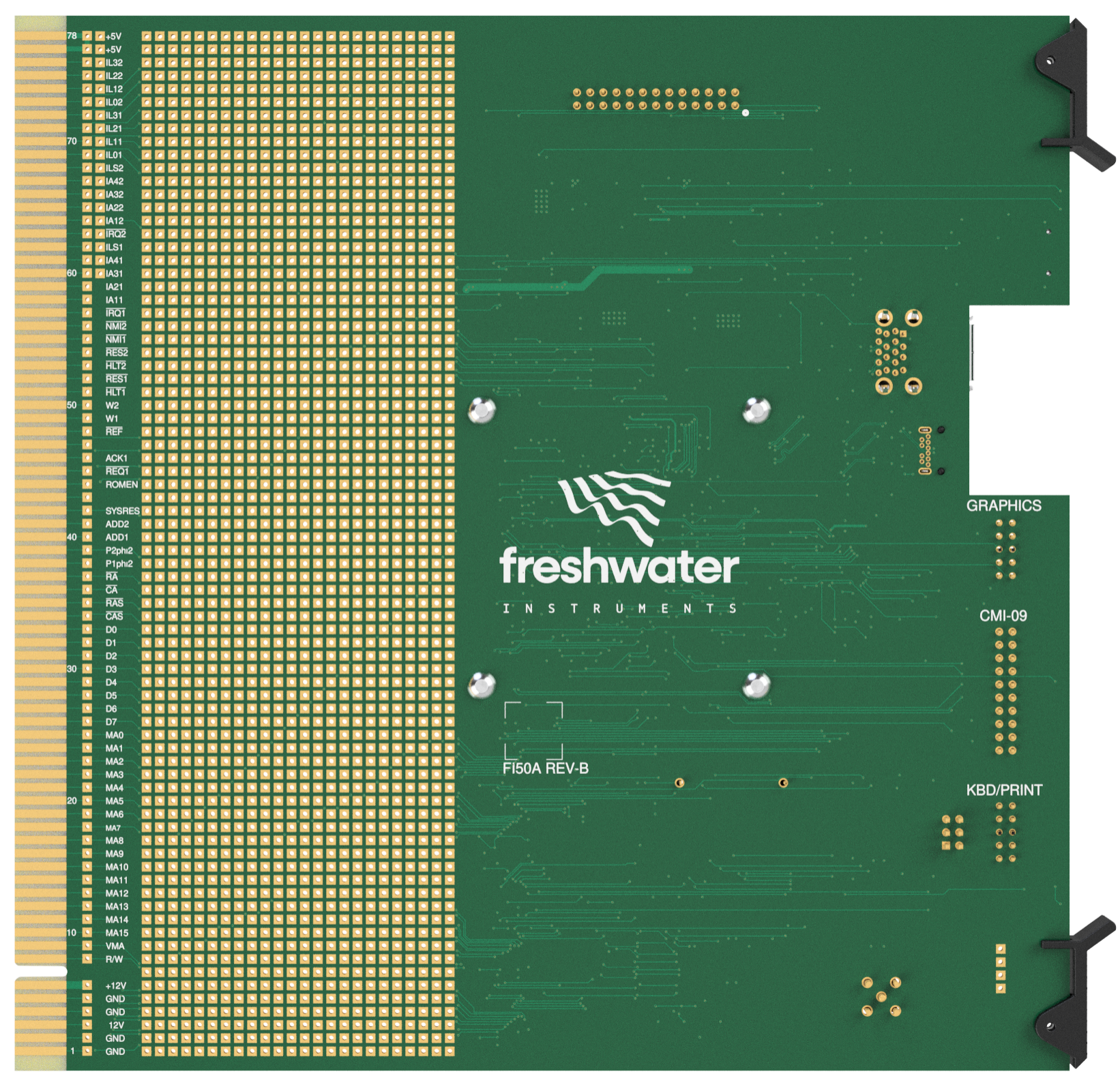
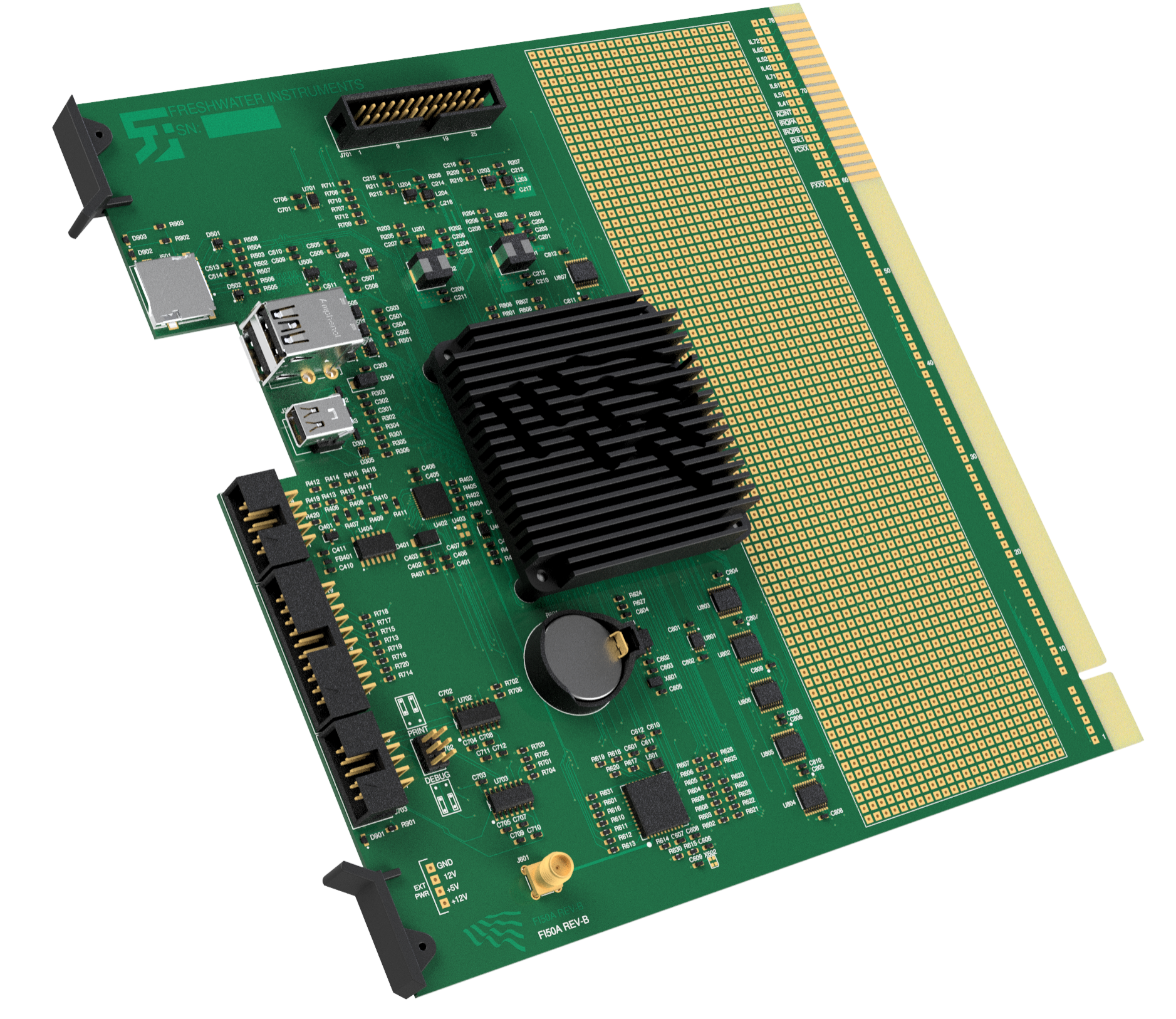
The Freshwater FI50A is a complete modern CPU card for the Fairlight CMI Series I, II and IIx. It replaces the original computer section while preserving the character, workflow and hardware experience of the CMI. Running enhanced software derived from the original source code, the FI-50A dramatically improves speed, reliability, storage and usability, while keeping the instrument recognisably and operationally a Fairlight CMI.
The FI50A arrives pre-installed with a fully licensed original CMI sound library and adds practical modern ways to expand it: enhanced 10-bit sampling, waveform upload over Wi-Fi, SD card and USB memory support. It also brings modern wireless interfaces, DisplayPort output, USB, Bluetooth and Wi-Fi, while retaining support for legacy CMI keyboards, CRT/light pen operation, floppy disks, MIDI interfaces and Series I/II channel cards. The full specification below details these hardware and software capabilities.
Installation is designed to be straightforward and reversible. With the online video guide, the original CPU and peripheral cards can be removed and preserved, the FI-50A installed in their place, and the original peripherals reconnected. For owners familiar with the CMI, the result is not a different instrument, but a transformed one: faster, more reliable, easier to manage and ready for contemporary studio use while remaining true to the original machine.
Specifications
-
CMI mainframe compatible 8” card with 78 contact edge connector compatible with CMI CPU bus.
Quad core ARM CPU running both Linux plus a separate RTOS for real-time processing of effects, channel cards and MIDI/keyboard I/O.
SD card slot for external sound library loading and software upgrades. FAT32, ext4, etc file system support.
Display port up to 4K resolution with auto scaling and hot-plug detect. Simultaneous operation with legacy CRT display supported.
Legacy CRT and light pen support via CMI compatible 10 pin connector.
512 x 256 x 32 pixel shades. Standard CMI resolution but with enhanced five bit grey/green scale support.
Dual USB-A 3.0 ports.
Fully supports series I and II channel cards.
4 port MIDI support (compatible with CMI29 - 3 MIDI inputs, 4 MIDI outputs). MIDI via USB support is also available - adds MIDI support to any CMI.
Supports QFC9 to image existing floppy disks. Working FD controller card is optional and not required. Transfer any legacy CMI library 8” floppy disk to the on-board memory or SD card.
Bluetooth 5.2 for keyboard and mouse support. Compatible with a wide range of USB keyboards.
Wi-Fi a/b/g/n/ac 2.4/5GHz support for remote file up and download via built-in web server.
Legacy alphanumeric and music keyboards fully supported.
Fully reversible installation. Replaces existing CPU (Q209), Memory (Q256), Control (Q133) and Graphics cards (Q219), MIDI processor (CMI32). Restore operation to any CMI with failed or missing processor cards.
All connectors match original CMI QASAR series processor cards.
No special skills or tool required for installation. Online video installation guide available, providing step-by-step instructions.
Large prototype area for custom experimentation and interfaces. Operate the card stand-alone with custom voice hardware for experimenters with the necessary technical skills.
8 GB of sample/waveform/sequence storage onboard (equivalent to 6000+ floppy disks). Plus external storage via USB and SD Card support.
Maximum power consumption ~33W. Significantly reduce the heat and load on the legacy CMI power supplies.
Onboard real-time clock/calendar with replaceable lithium coin cell. Eliminate the risk of battery acid leakage from the ancient on-board Tadiran lithium battery.
Eliminates/replaces the need for separate floppy emulator + composite to HDMI adaptor + Mouse to light pen adaptor with one fully integrated card. Provides >USD 1000 included value in replacement accessories built-in.
Preserves overall look and operation of the original hardware.
The FI50a is covered by a standard 12-month warranty.
-
Overview
Turn key options with fully configured software pre-installed. Complete original Fairlight CMI ported software release - The FI50A runs the original CMI IIx software release immediately upon installation - based on the original source code. Operates exactly like the original CMI when all enhanced features are disabled. (except >100x faster)
Approximately five second boot time. The CMI is ready to go faster than the CRT cathode has time to warm up.
Complete and definitive Series 1/2/2x sound library licensed and pre-installed.
Future software updates via SD and USB memory. Many enhanced software features in the pipeline.
Built in web-server to manage file up and download.
Configuration of Wi-Fi and Bluetooth via custom wireless configuration page (Page W)
Supports standard FD emulator images installed on the SD card or USB memory. Transfer your Floppy disk emulator images directly.
Numerous user interface visual enhancements throughout while retaining the legacy CMI user interface look retaining Light pen support plus mouse compatibility. Some of the enhancements include:
o Anti-aliased/smoothed waveform displays
o Modern scrollbars, drop down lists and check boxes
o Improved display formatting with use of proportional fonts
o Enhanced context sensitive mouse cursors
New features/enhanced functions on initial launch
Page 8/Sampling
Support for higher sample rates and 10-bit sampling. Software will gain/scale sampled waveforms to maximise voice quality on legacy 8 bit channel cards. Unlock the never before available additional 2 sampling bits available in the original CMI!
Up to 16 seconds of sample capture with interactive post capture down-sampling/LP/HP filtering and gaining (Note, this does not increase the available memory/playback/resolution of the existing channel cards). Adjust sampling/gain/filter parameters post sampling to get the perfect loop every time.
Real time waveform display, with stacked waveform (Page D) and envelope displays taking full advantage of the new grey-scale graphics capability.
Pages 2, L
Double click voice/instrument/sequence loading. Load any voice in fractions of a second. Load a complete Instrument file (8 voices) in under one second.
Automatic voice preview on Page 2. Plays the highlighted voice polyphonically automatically upon selection, without unloading the instrument configuration.
Support for sub-folders to organise legacy disk images and the sound library. Automatically creates a “Page L” like display based on the organisation of your sound library folders.
Fully searchable file names/voices. Also features automatic command auto completion - no need to type the entire VC file name - auto complete the name based on selected disk image/folder using the tab key.
Support for long file names and sub folders to easily organise your projects and sound library.
Additional pages
Video test pattern page to adjust your CRT brightness and contrast settings for optimum performance.
Configuration options page (Page O) to enable and display individual feature enhancements. Operate your upgraded CMI in stock form at blistering speed or enable all of the enhanced features to maximise the CMI experience for the 21st century.
Use a second screen or the CRT display to enable the original dual TVT card displays. This rare card was used by the original software developers to obtain debug output and monitor the CMI states in real time during software development and testing. Unlock this behind-the-scenes feature using a second display.
All new software features include built-in help pages, fully integrated with the legacy CMI help page system. All of the documentation is available literally at your fingertips.
Wireless configuration page (Page W). Configure your Wi-Fi and Bluetooth devices via the new Page W.
A selection of screen savers to avoid CRT burn in. Including a few easter eggs.
Pages 4, 5, 6
Higher resolution real-time effects processing (glides, vibrato/bends at higher resolution and refresh rates). Turn on fast real-time effects processing to enable smoother filter and pitch control or set to legacy mode for traditional crunchy/zippery 80’s CMI experience.
Full floating point resolution FFT. Support for high resolution FFT with overlapping waveform segments. Provides far greater control for voice sculpting. And all with near instantaneous analyse and compute functions.
Interactive FFT and real-time additive synthesis with instant audible feedback. Eliminates the need to run Analyse and Compute commands after each change. Totally transform the additive synthesis experience of the legacy CMI.
Page R/Sequencing
Control recording on Page R. Record unlimited controllers, switches and pitch-bend for each Page R part.
Polyphonic record. At last!
Variable swing/shuffle. Adjust swing from 0 to 100%.
Non-quantised recording with quantisation enable/disable supporting legacy operation. Adjustable quantisation from 0 (non-quantised) to 100% (snapped to grid/legacy mode).
Solo and mute buttons per channel.
Background playback of all sequencers (Page 9/MCL/Page R)
Comprehensive MIDI sync in and out. Extends original Page R MIDI support beyond just the legacy trigger function.
Step time recording. Play notes on the keyboard step by step with automatic cursor stepping.
Some future road-map features coming later this year
Thanks to the FI50A CPU card, your CMI will once again be a modern, supported product with ongoing enhancement and active software development. Here are just a few enhancements that Freshwater is planning for a future software release this year.
Additional parts/voices supported on Page R
Complex tempo control in Page R
Additional quantisation and swing/shuffle features
New display pages providing enhanced wave-table synthesis functionality.
Integration of MCL into Page R. Write custom MCL patterns and play them directly as part of your Page R composition.
Support for custom display pages, synthesis and sequencers. Write your own plug-in display pages in Python, C/C++ or the language of your choice and integrate them directly into Page 1. Freshwater Instruments will be releasing a comprehensive software API enabling anyone to write custom software for the CMI and integrate into the application to work alongside the native CMI software.
Open voice driver API. Write custom drivers for your own channel card hardware. Build your own flavour of CMI around this CPU card and any channel hardware you can imagine and build. Combined with the custom display page API, you could even drive a modular synth with native built-in CMI displays fully integrated.
Remote user interface via Wi-Fi. Control your CMI without the need for an attached screen/keyboard/mouse/light-pen. By downloading and installing the remote CMI user interface thin-client application on your PC, access the complete CMI user interface using you laptop or desktop PC. Coming soon.

"I remember having lunch with the team in Ryrie House in about 1985 and talking about the 68020 which would shortly become available. It had 190,000 transistors and ran at 12MHz. I said “One day the whole CMI will probably fit on one chip”. We all had a laugh at that. Fast forward 40 years and that’s the reality. By making this new board from Freshwater that is compatible with the original CMI channel cards, the bits that make the CMI sound so unique are still there, while the digital part is a zillion times more powerful, smaller, cheaper and reliable. I guess there are still 100 or so CMI’s in use and It’s great to know they could live another 40 years with this update”
– Peter Vogel
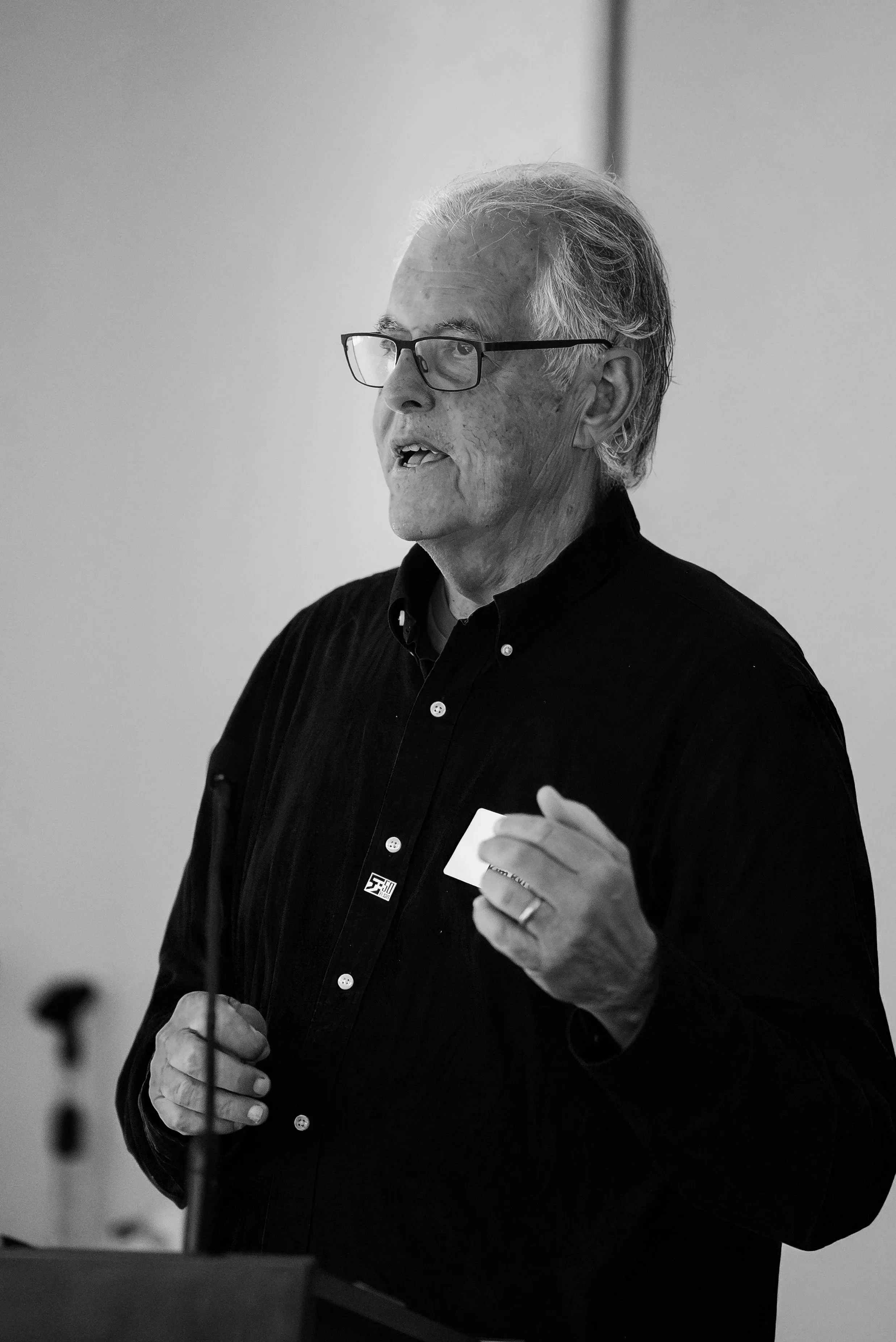
"About four decades ago I mentioned to prospective buyers of our first Computer Music Instrument in the late 70's, that being a computer, it will never be finished but will keep getting better through endless upgrades. Although this upgrade has taken four decades; it proves that good things come to those who wait. So, congratulations to Paul and the Freshwater team, which includes input from our original team. It brings a lot of things that were stuck on the wish list into the 21st century by transcending our original knife and fork technology while retaining much of the original magic".
– Kim Ryrie
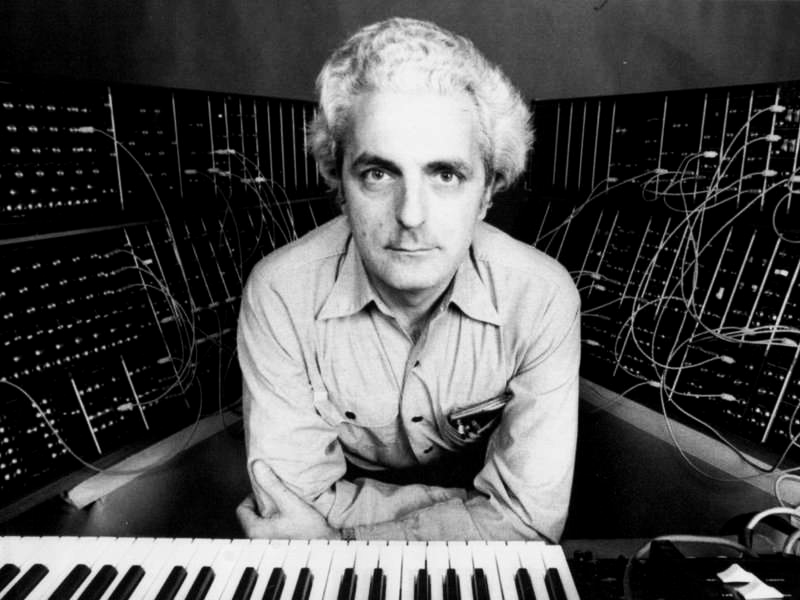
“This is not a machine that will go out of date this year, or next year, or as far as I can see 10 years from now. What it does is just too useful musically and too general and too versatile to be limiting in an significant way"
– Robert Moog
Frequently Asked Questions
-
The FI50A will be available for AUD 2100, with approximate pricing of USD 1500, EUR 1300 and GBP 1150. Prices are subject to exchange rate fluctuations at the time of purchase and exclude freight costs and any local taxes applicable in the destination country.
This product will be available to order from the Freshwater Instruments store in mid to late August 2026, with deliveries beginning in September 2026.
-
The FI50A is compatible with the Fairlight CMI series I, II and IIx.
-
The FI50A is electronically and physically compatible with Series III, however we do not currently support Series III software or channel cards. We are open to third-party development, and our API provides the necessary tools to enable such integration.
-
Using the supplied programming API, experienced developers and electronics experimenters can create custom sound hardware and interfaces for analog synth racks and external applications, limited only by their imagination. The 50A CPU card can be operated stand alone with your own hardware from a single 12V power supply. The card features a generous prototyping area for creating custom interfaces and circuits.